10 Best LearnUpon LMS Alternatives in 2026 (With Real Prices)
Learnwick LMS is the best LearnUpon alternative in 2026 for training your own employees. It is quick to set up, has no active-user minimums or annual lock-in and publishes its prices. It is free for up to 30 learners, then from $79/month billed yearly ($99 monthly) for up to 100 learners. For customer and partner portals, look at Absorb or Docebo.
Key takeaways
- LearnUpon is quote-only, typically about $6–$9 per active user per month, with a Vendr median of about $30,000 a year and no free plan.
- Learnwick LMS is the low-cost alternative for employee training: free for up to 30 learners, published prices and every feature on every plan.
- Absorb and Docebo are the closest enterprise swaps for multi-portal training; TalentLMS, iSpring Learn and ProProfs publish their prices.
- Decide first whether you train only employees or also customers and partners — it changes the shortlist.
In this guide
- In summary
- How we compared these LearnUpon alternatives
- Why teams look for LearnUpon alternatives
- The 10 best LearnUpon alternatives at a glance
- 1. Learnwick LMS
- 2. Absorb LMS
- 3. TalentLMS
- 4. Docebo
- 5. iSpring Learn
- 6. 360Learning
- 7. ProProfs Training Maker
- 8. Tovuti LMS
- 9. Bridge
- 10. Moodle and MoodleCloud
- What a LearnUpon alternative really costs
- Questions to ask any LearnUpon alternative
- Feature comparison: LearnUpon alternatives side by side
- Other LearnUpon alternatives worth a look
- How to switch from LearnUpon to a new LMS
- Choose a LearnUpon alternative by what you need
- Frequently asked questions
In summary
If you only have a minute, here’s the short version:
- Best overall for employee training:Learnwick LMS — free for up to 30 learners, then $79/month billed yearly ($99 monthly) for up to 100 learners. SCORM, video, PDF, quizzes, certificates and an AI course builder on every plan.
- Best free plan:Learnwick LMS — 30 learners, every feature, no time limit. LearnUpon has no free plan.
- Best budget LearnUpon alternative:Learnwick LMS — $948 a year for up to 100 learners, with no minimum commitment.
- Lowest per-learner price:Learnwick LMS — $0.79 per learner per month on Starter (100 learners) and as little as $0.40 on Business (1,000 learners), billed yearly.
- Closest like-for-like for customer and partner training: Absorb LMS or Docebo (quote-based).
- Best well-known self-serve LMS: TalentLMS.
- Best for PowerPoint-built courses: iSpring Learn.
Disclosure: Learnwick LMS publishes this guide and is one of the products in it. We put it first simply because it’s the option we know best for small and mid-size teams, and we list its limits as plainly as everyone else’s. Prices and G2 ratings for other tools were checked in November 2026 from vendor pages, G2 and public price trackers; check the vendor’s own page before you buy.
How we compared these LearnUpon alternatives
LearnUpon is a well-liked corporate LMS. It holds a 4.5 rating from about 250 G2 reviews, and reviewers consistently rate its setup as quick and its support as responsive. It is especially strong when one company trains several audiences — staff, customers and partners — each in its own portal.
So the question here is not “what beats LearnUpon?” but “what fits better when LearnUpon’s pricing, minimums or focus don’t match your team?” We scored each alternative on:
- Price you can see. Published prices, free plans and self-serve trials.
- Minimums and contracts. Active-user minimums, annual commitments and what happens when you go over.
- Audiences. Employees only, or customers and partners too.
- Everyday admin. Due dates, reminders, certificates, overdue lists and simple reports.
- Courses you already own. SCORM, xAPI, video and documents.
We used vendor pricing pages, G2 ratings and public price trackers (Vendr) in November 2026. For quote-only tools, we give the range buyers report and label it as an estimate.
Why teams look for LearnUpon alternatives
Teams don’t usually leave LearnUpon because it is hard to use. They leave, or decide not to buy, because of how it is priced and who it is packaged for.
Pricing is quote-only
LearnUpon does not publish prices. Buyers report paying roughly $6 to $9 per active user per month, and Vendr puts the median contract at about $30,000 a year. That is reasonable for a mid-size company with a training budget, but a large commitment for a first LMS.
Plans start at around 100–150 active users
LearnUpon packages its plans by audience. The employee-training plan is built around 100 monthly active users, and the customer-education and association plans around 150. Smaller teams pay for capacity they don’t use yet.
No free plan and an annual commitment
There is no free plan, and many buyers report a minimum annual commitment. Testing means a demo and a sales-led trial rather than signing up and trying it with your own team.
Paying for portals you don’t need
LearnUpon’s strength — separate portals for customers, partners and members — is wasted if you only train your own staff. Teams with one audience often find a simpler, cheaper LMS covers everything they use.
Active-user pricing can be hard to predict
Monthly active-user pricing is fair in theory, but a busy onboarding month or an annual compliance push can spike usage. Teams that want a flat, predictable bill prefer plans priced by learner count.
Before you switch, list which LearnUpon portals and integrations you actually use. If it is one portal and SSO, your options open up a lot.
The 10 best LearnUpon alternatives at a glance
| Tool | Best for | Price (Nov 2026) | G2 rating | Free plan |
|---|---|---|---|---|
| Learnwick LMS | Employee training for small and mid-size teams | Free up to 30; from $79/mo for 100 learners | New (no reviews yet) | Yes, 30 learners |
| Absorb LMS | Enterprise training for employees, customers and partners | Quote only (median ≈$20,000/yr) | 4.6 (≈900 reviews) | No |
| TalentLMS | A simple, well-known self-serve LMS | Free for 5 users; Core from $119/mo yearly | 4.6 (≈800 reviews) | Yes, 5 users |
| Docebo | Large, global, multi-audience programs | Quote only (median ≈$42,000/yr) | 4.3 (≈740 reviews) | No |
| iSpring Learn | Teams that build courses in PowerPoint | From $6.91/user/mo at 100 users, billed yearly | 4.5–4.6 | No (30-day trial) |
| 360Learning | Experts writing courses together | Team plan $8/user/mo, up to 100 users | 4.6 (≈600 reviews) | No |
| ProProfs Training Maker | Paying only for active learners | Free for 10; from $1.99/learner/mo | 4.5–4.6 | Yes, 10 learners |
| Tovuti LMS | Authoring, events and LMS in one product | Quote only | 4.6 (≈295 reviews) | No |
| Bridge | Learning plus performance and careers | Quote only | 4.2 (≈390 reviews) | No |
| Moodle / MoodleCloud | Open-source control | Free to self-host; MoodleCloud from about $160/yr | — | Open source |
1. Learnwick LMS
Best for: small and mid-size teams (10 to 1,000 learners) training their own employees who want LearnUpon’s quick setup without a quote, a minimum or an annual commitment.
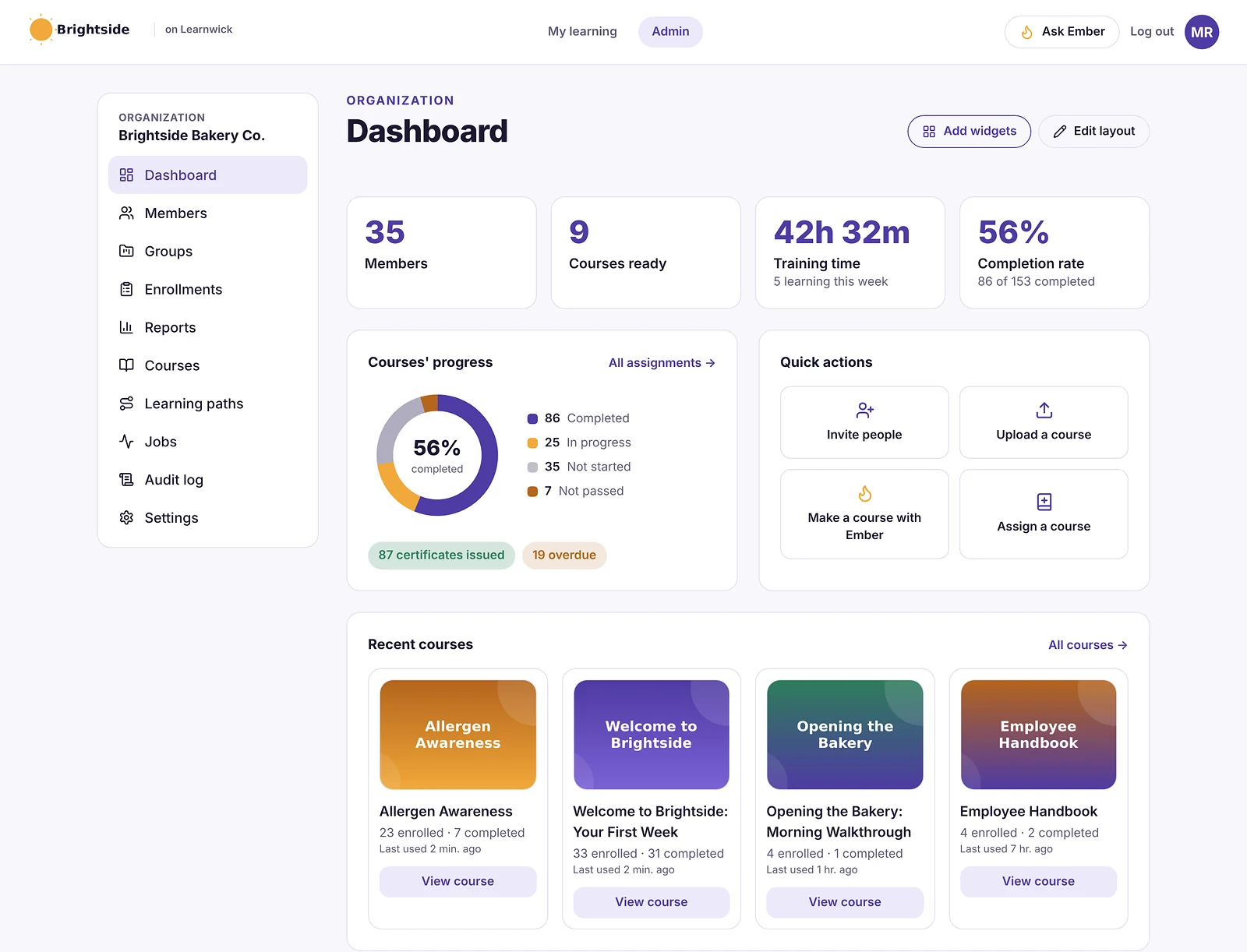
Learnwick LMS is a cloud LMS for teams without a training department. One person can set it up in an afternoon: create a workspace, add your logo, upload a SCORM course or let the AI assistant build one from a document, invite people and assign training with a due date. Learners open it on any phone or computer without an app.
Why Learnwick is a strong LearnUpon alternative
Even faster to start. LearnUpon is known for quick setup after the sale. Learnwick skips the sale: sign up, upload a course and assign it the same day. The Free plan covers 30 learners with every feature and no time limit.
Predictable prices. Plans are priced by learner count, not monthly active users, and published on the pricing page. A busy onboarding month doesn’t change your bill.
No minimums. Start with 3 people or 300. Pay monthly or yearly and cancel any time.
Every feature on every plan. Paid plans only change the number of learners.
The honest trade-off: Learnwick is built for training your own team. It doesn’t have separate customer or partner portals, course selling or CRM integrations. If customer education is your main use of LearnUpon, look at Absorb or Docebo below.
To give you a concrete example, at Learnwick, we don’t simply sell setup as a project. One person can create the workspace, upload courses and invite people with a join link in an afternoon, so that training starts this week rather than next quarter. In practice, that matters most for teams without an L&D department.
Key features
- Courses you already have:SCORM 1.2 and single-SCO SCORM 2004 packages from Storyline, Rise, Captivate or iSpring, plus videos and PDFs.
- Ember AI course builder: drafts lessons and quizzes from a policy, PDF or Word file, and translates courses — an admin approves every change.
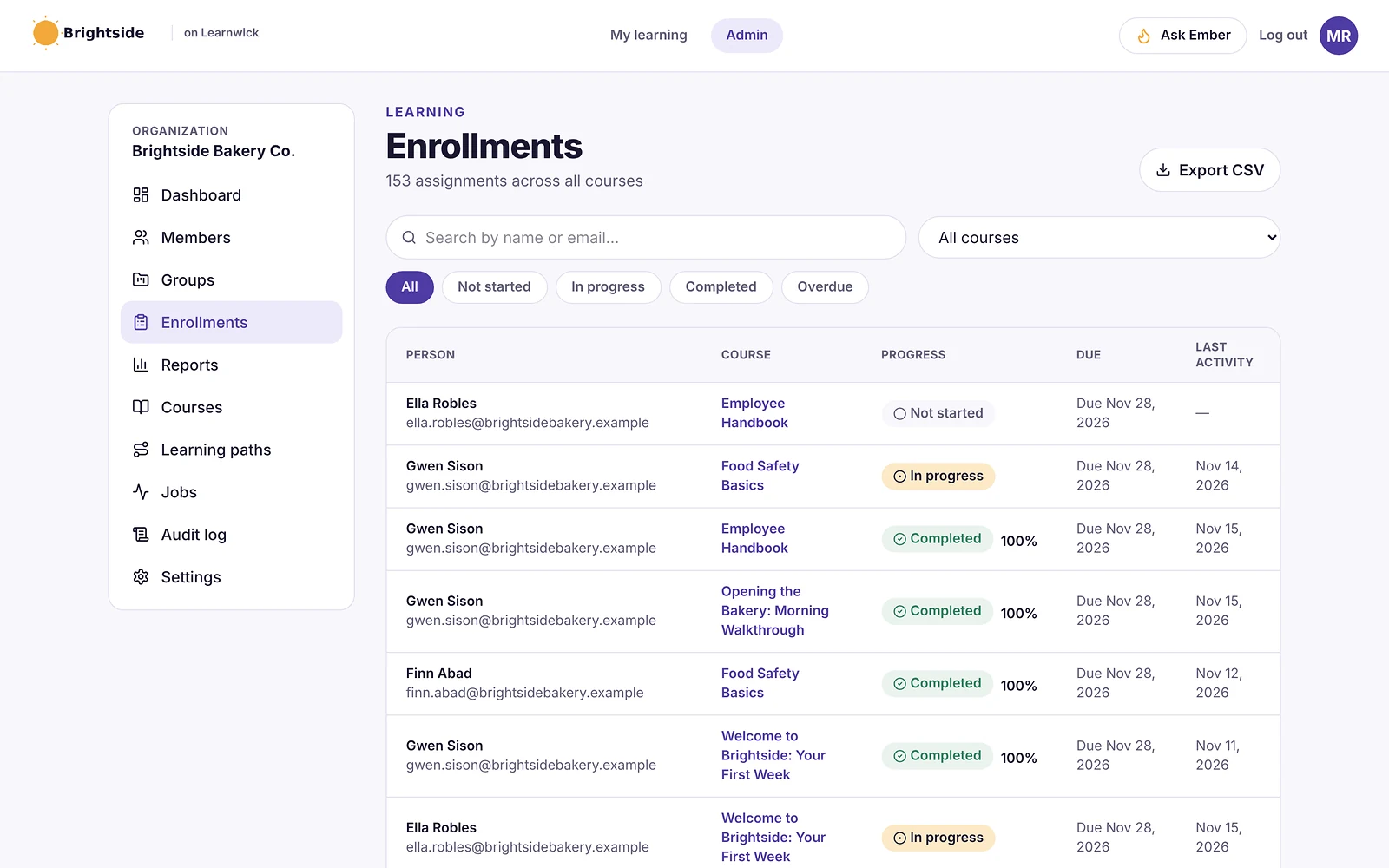
- Groups and automatic assignments: required courses per group with due dates; new members get them automatically.
- Reminders: late reminders, weekly manager summaries and next-course automation.
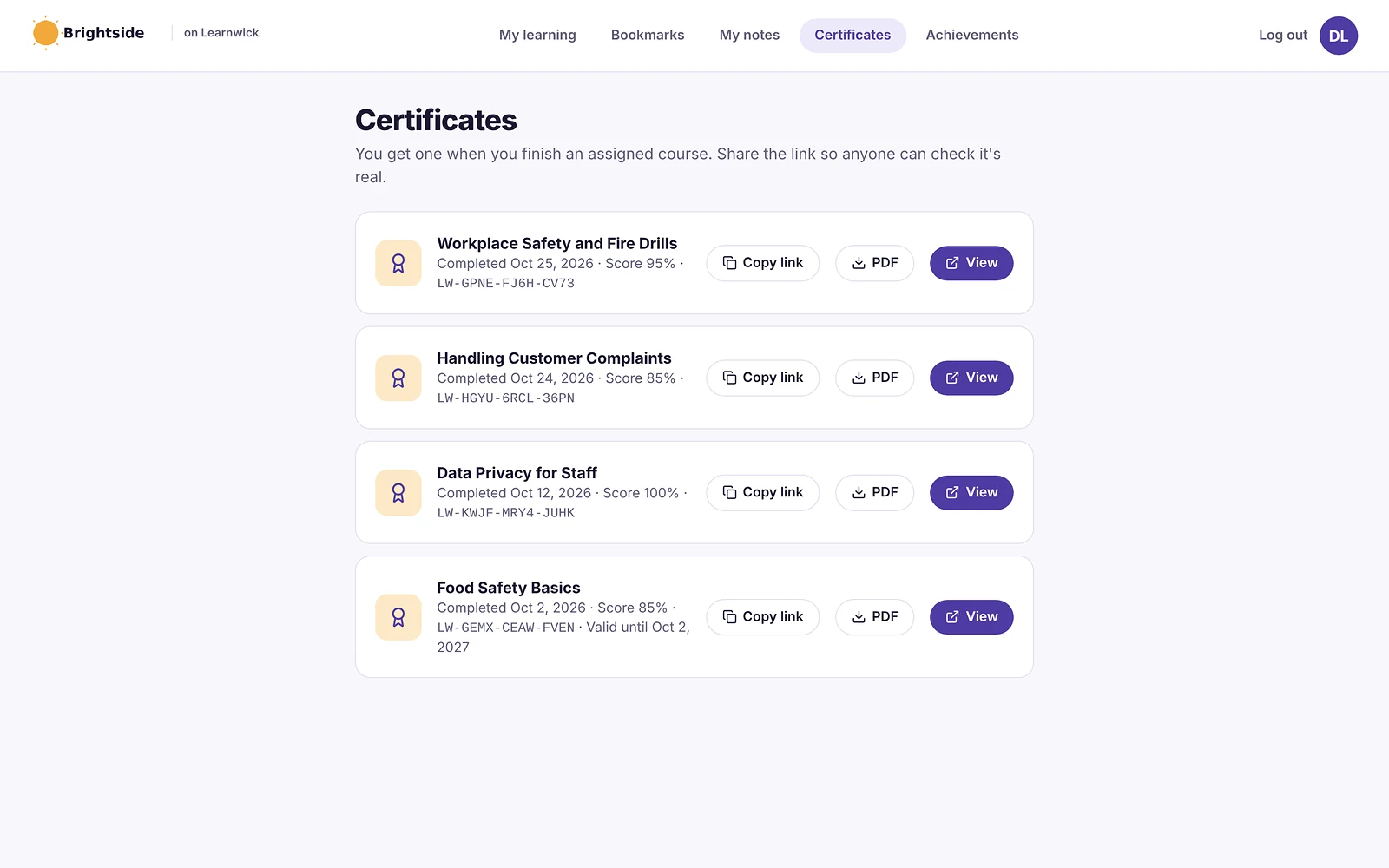
- Certificates:PDF certificates with renewal dates and online verification.
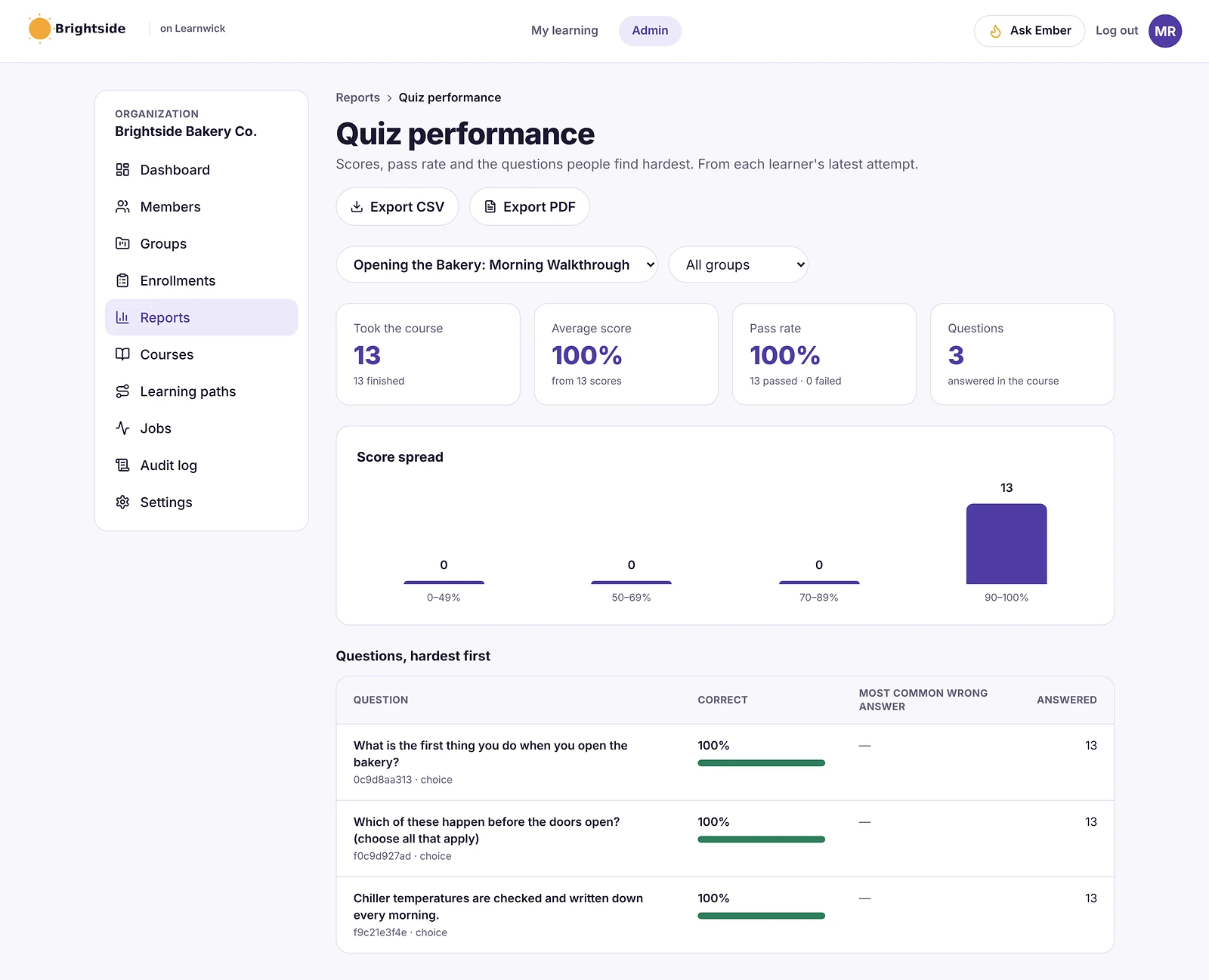
- Reports: overdue list, completion and quiz reports, time spent, analytics dashboards, custom reports, a training matrix and gaps by role, with CSV export.
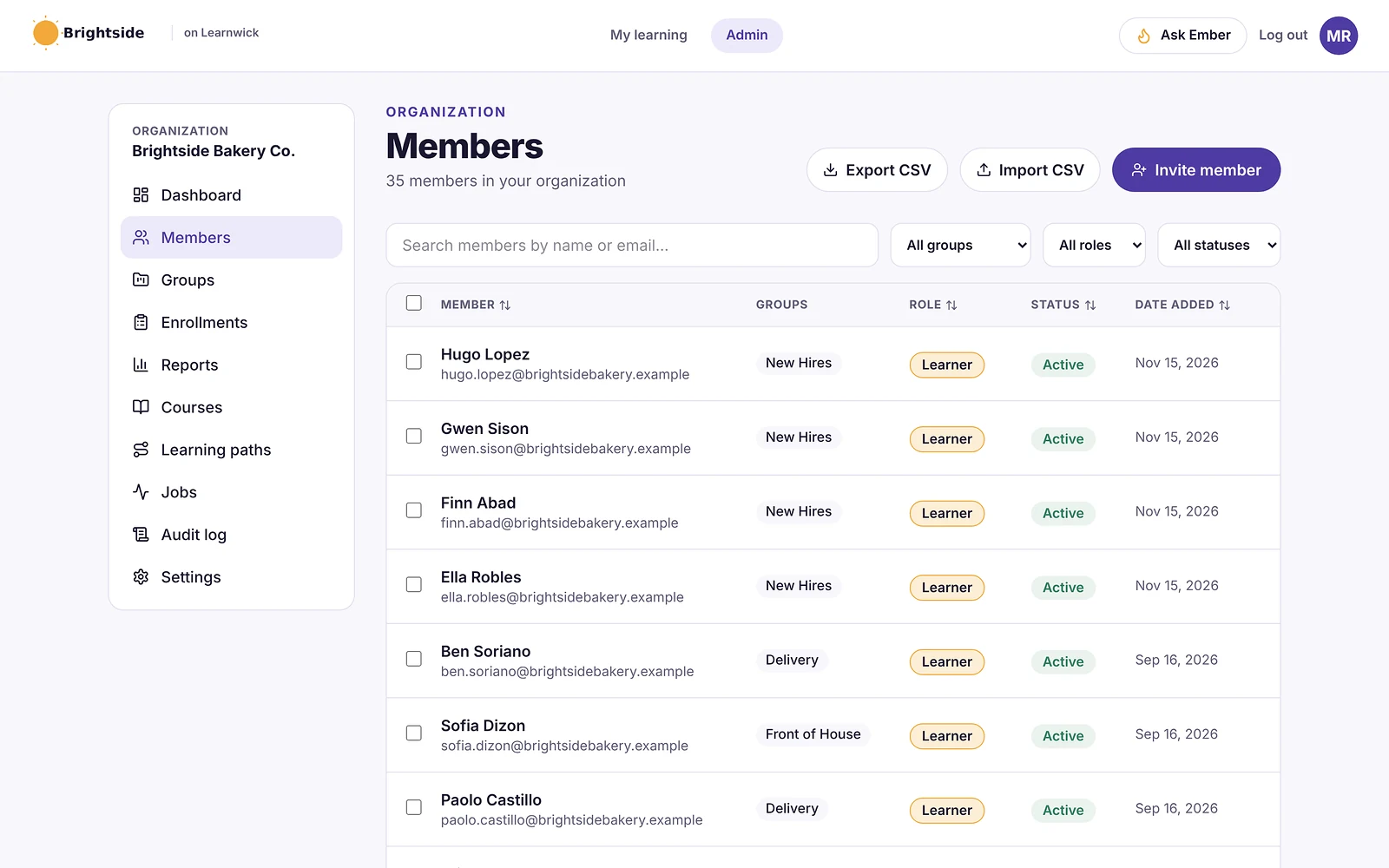
- Sign-in options: invites, CSV import, join links limited to your email domain, and Google or Microsoft sign-in.
- For mixed teams: learner emails in English, Filipino, Cebuano, Spanish or Indonesian.
Pros
- Free for up to 30 learners with every feature.
- Published prices, no minimum users, no annual lock-in.
- Set up in an afternoon.
- Plays the SCORM courses you already have.
- Works on any phone without an app.
Cons
- No connection to HR or payroll systems yet (people come in by invite, CSV, a join link, or Google/Microsoft sign-in).
- No xAPI, cmi5 or multi-SCO SCORM 2004 with sequencing.
- No live classes or virtual classroom, and no selling courses to the public.
- No native mobile app (the web app works on any phone) and app screens are in English only.
- A young product: few third-party reviews yet, and a small ready-made course library.
Pricing
- Free: up to 30 learners, every feature, no time limit.
- Starter: $79/month billed yearly ($99 monthly) for up to 100 learners.
- Growth: $239/month billed yearly ($299 monthly) for up to 500 learners.
- Business: $399/month billed yearly ($499 monthly) for up to 1,000 learners.
- Enterprise: over 1,000 learners, price on request.
For comparison: at $6 per active user per month, 100 active LearnUpon users would cost about $7,200 a year. Learnwick Starter covers 100 learners for $948 a year.
Learnwick LMS · Free plan
Try Learnwick LMS free
Upload one of your LearnUpon SCORM courses, invite five people and see the overdue report today. Free for up to 30 learners, no credit card.
2. Absorb LMS
Best for: larger organizations that train employees, customers and partners and want a polished enterprise LMS.
Absorb is a well-reviewed corporate LMS with a 4.6 G2 rating from roughly 900 reviews. It offers branded portals, e-commerce, compliance tracking and strong automation.
Why Absorb is a LearnUpon alternative
Absorb covers LearnUpon’s multi-audience scope and adds e-commerce and a wide integration catalogue. Price trackers put its median contract around $20,000 a year, often lower than LearnUpon’s median.
Key features
- Branded portals for different audiences.
- Rule-based enrollments and learning paths.
- E-commerce for selling courses.
- Compliance and certificate tracking.
- Integrations and an API.
Pros
- Highly rated for ease of use.
- Strong automation and reporting.
Cons
- Quote-only; plans start at 100 learners.
- Annual contracts and an implementation project.
Pricing
Quote only. See our Absorb LMS alternatives guide.
3. TalentLMS
Best for: small teams that want a well-known, simple LMS they can buy online.
TalentLMS has a 4.6 rating from about 800 G2 reviews and a reputation for being easy to learn. You can sign up and start without a sales call.
Why TalentLMS is a LearnUpon alternative
TalentLMS gives you published prices and self-serve plans, plus branches (sub-portals) on Grow and Pro if you need light multi-audience training.
Key features
- Course builder with tests, surveys and assignments.
- SCORM, xAPI and cmi5.
- Branches on higher plans.
- Gamification and automations.
Pros
- Free plan and published prices.
- Very easy to use.
Cons
- Free plan is small (5 users, 10 courses).
- Prices step up by user bracket.
Pricing
Free for 5 users; Core $119 a month billed yearly for up to 40 users; Grow $229; Pro $449. See our TalentLMS alternatives guide.
4. Docebo
Best for: large organizations running global programs for several audiences.
Docebo is an enterprise learning platform with strong AI, extended-enterprise portals and a branded mobile app. It has a 4.3 rating from about 740 G2 reviews.
Why Docebo is a LearnUpon alternative
If you are leaving LearnUpon because you need more — more automation, more AI, more integrations — Docebo is a step up. It is not a cheaper choice: Vendr’s median Docebo contract is about $42,000 a year.
Key features
- AI content creation and recommendations.
- Extended-enterprise portals.
- Branded mobile app and integration marketplace.
Pros
- Very capable for complex programs.
- Mature AI features.
Cons
- Quote-only; aimed at 250+ learners; multi-year contracts are common.
Pricing
Quote only. See our Docebo alternatives guide.
5. iSpring Learn
Best for: teams whose training is built in PowerPoint.
iSpring Learn pairs with iSpring Suite, a PowerPoint-based authoring tool, so slides become interactive courses and publish straight to the LMS.
Why iSpring Learn is a LearnUpon alternative
iSpring publishes prices by user band and offers a 30-day trial — two things LearnUpon doesn’t. Its 100-user band is close in price to LearnUpon’s low end.
Key features
- SCORM, video, documents and iSpring Suite courses.
- Learning paths and enrollment rules.
- Reports and a mobile app with offline mode.
Pros
- Public prices and a free trial.
- Strong support reputation.
Cons
- No free plan; smallest band is 100 users.
- iSpring Suite is a separate purchase.
Pricing
Billed yearly: $8,286 for 100 users, $16,050 for 300 and $23,790 for 500. See our iSpring alternatives guide.
6. 360Learning
Best for: companies that want experts to write and update courses together.
360Learning focuses on collaborative authoring, with a 4.6 rating from about 600 G2 reviews.
Why 360Learning is a LearnUpon alternative
LearnUpon is admin-led; 360Learning is expert-led. If your problem is content, not portals, it may fit better — and its Team plan has a published price.
Key features
- Collaborative authoring and AI-assisted writing.
- SCORM support and discussions.
- HR integrations on higher plans.
Pros
- $8 per user per month entry price.
- Monthly billing on the Team plan.
Cons
- Team plan stops at 100 users; larger plans are quoted.
- No free plan.
Pricing
Team: $8 per user per month for up to 100 users. Business and Enterprise: quote.
7. ProProfs Training Maker
Best for: teams that like active-user pricing but want it published and cheaper.
ProProfs Training Maker bills per active learner, like LearnUpon, but publishes its prices and starts under $2 per learner per month.
Why ProProfs is a LearnUpon alternative
If active-user pricing suits you but LearnUpon’s minimums don’t, ProProfs gives you the same model at a much lower entry point, plus a small free plan.
Key features
- AI-assisted course creation and quizzes.
- Uploads for video, PowerPoint and documents.
- Ready-made course library and branded portal.
Pros
- Very low per-learner price.
- Free for up to 10 learners.
Cons
- Fewer reviews than LearnUpon.
- Dropping back to free deletes stored attempts and scores, according to ProProfs.
Pricing
Free for 10 learners; Essentials from $1.99 and Business from $3.99 per active learner per month, billed yearly. See our ProProfs alternatives guide.
8. Tovuti LMS
Best for: teams that want authoring, virtual events and an LMS in one product.
Tovuti includes a built-in interactive authoring tool, virtual classrooms, gamification and white-label branding. It has a 4.6 rating from about 295 G2 reviews.
Why Tovuti is a LearnUpon alternative
Tovuti serves similar audiences — including associations and customer training — with authoring and events built in, so you need fewer separate tools.
Key features
- Interactive authoring.
- Virtual classrooms and events.
- Gamification and white-label branding.
Pros
- One tool to build and deliver.
- Strong engagement features.
Cons
- Quote-only; starting package built around 100 users.
Pricing
Quote only.
9. Bridge
Best for: mid-size companies that want learning tied to performance and career development.
Bridge combines an LMS with one-to-ones, goals, check-ins and career tools. It holds a 4.2 rating from about 390 G2 reviews.
Why Bridge is a LearnUpon alternative
If your LearnUpon use is mostly employee development, Bridge adds the manager side — check-ins and goals — that LearnUpon doesn’t focus on.
Key features
- LMS with learning paths and compliance.
- Performance check-ins, goals and one-to-ones.
- Skills and career development.
Pros
- Learning and performance in one product.
- SOC 2 Type II and 24/7 support.
Cons
- Quote-only; G2 users estimate about three months to implement.
Pricing
Quote only. See our Bridge alternatives guide.
10. Moodle and MoodleCloud
Best for: organizations with technical staff who want open-source control.
Moodle is the world’s best-known open-source LMS. Self-host it, buy MoodleCloud, or license Moodle Workplace through a partner.
Why Moodle is a LearnUpon alternative
Moodle Workplace’s multi-tenancy can recreate LearnUpon-style portals for different audiences, and you own the code.
Key features
- Open source with thousands of plugins.
- SCORM, quizzes, badges and certificates.
- Multi-tenancy in Moodle Workplace.
Pros
- No licence fee if you self-host.
- Full control over data and hosting.
Cons
- Running it is your job (servers, updates, security).
- MoodleCloud has user caps and no custom plugins; Workplace is partner-priced.
Pricing
Free to self-host. MoodleCloud about $160–$2,120 a year for 50 to 750 users. See our Moodle alternatives guide.
What a LearnUpon alternative really costs
Because LearnUpon prices on monthly active users, your bill depends on how many people log in. The table below assumes every learner is active each month at the $6–$9 per user range buyers report, next to tools with published prices.
| Team size | Learnwick LMS (yearly) | iSpring Learn (yearly) | LearnUpon (estimate) | Docebo (estimate) |
|---|---|---|---|---|
| 30 learners | Free | $8,286 (100-user band) | Plan minimums apply | Not aimed at this size |
| 100 learners | $948 (Starter) | $8,286 | About $7,200–$10,800 | Not aimed at this size |
| 300 learners | $2,868 (Growth) | $16,050 | About $21,600–$32,400 | Often $21,000+ |
| 500 learners | $2,868 (Growth) | $23,790 | About $36,000–$54,000 | About $35,900 (AWS listing, 36 months) |
| 1,000 learners | $4,788 (Business) | About $43,000 | Quote | Quote (median deal ≈$42,000) |
If only half your people train in a typical month, LearnUpon’s active-user bill would be roughly half these figures. If you onboard in waves or run an annual compliance push, the busiest month sets the tone. Flat plans priced by learner count, like Learnwick’s, cost the same in a quiet month and a busy one.
Ask LearnUpon how “active” is counted, what happens when you exceed your plan in a month and whether unused capacity rolls over. Those three answers decide what you really pay.
Questions to ask any LearnUpon alternative
Whichever tools make your shortlist, ask each vendor the same questions so the answers are easy to compare:
- Can I try it with my own courses and people, without a sales call? A free plan or self-serve trial lets you test real SCORM packages, not a demo account.
- How is the price counted? Per registered learner, per active learner or per bracket — and what happens the month you go over.
- Is there a minimum term? Monthly, yearly or multi-year, and how much notice you must give.
- Which features are on which plan? Reminders, certificates, custom reports and SSO are often on higher tiers.
- Does it play my courses? Check SCORM 1.2, SCORM 2004 and xAPI separately, and test your biggest course.
- How do people get in? CSV import, join links, Google or Microsoft sign-in, SSO or an HR connector.
- What do managers see? A weekly summary or an overdue list saves the admin hours of chasing.
- Can I export everything later? Courses, users, completions and certificates, in a format you can open.
Write the answers in one shared table. The right tool is usually obvious once you see the gaps side by side.
Feature comparison: LearnUpon alternatives side by side
Prices change. But the way a tool is built and sold usually changes much less. This table shows where each option runs, whether it plays the SCORM courses you may already own, and how it is priced.
| Tool | Where it runs | SCORM | Pricing model |
|---|---|---|---|
| Learnwick LMS | Cloud (nothing to install) | Yes (1.2 and single-SCO 2004) | Published, free up to 30 learners |
| Absorb LMS | Cloud | Yes (plus xAPI) | Quote |
| TalentLMS | Cloud | Yes (plus xAPI, cmi5) | Published |
| Docebo | Cloud | Yes (plus xAPI) | Quote |
| iSpring Learn | Cloud | Yes | Published |
| 360Learning | Cloud | Yes | Published (Team) / quote |
| ProProfs Training Maker | Cloud | Yes | Published |
| Tovuti LMS | Cloud | Yes | Quote |
| Bridge | Cloud | Yes | Quote |
| Moodle / MoodleCloud | Self-hosted or MoodleCloud | Yes | Free / published |
“Via add-on” means a third-party plugin is needed. “Quote” means you need a sales call to get a price.
Other LearnUpon alternatives worth a look
These didn’t make our top 10 for most teams. But they come up often, and one of them may genuinely suit a specific need:
- Thought Industries: an enterprise platform for customer, partner and paid education.
- Skilljar: a customer education platform, now sold by Gainsight.
- Gainsight Customer Education (Northpass): a customer training platform (see our Northpass alternatives guide).
- LearnWorlds: a hosted course platform with interactive video.
- Litmos: a corporate LMS with a large ready-made course library.
- Continu: a modern corporate learning platform.
How to switch from LearnUpon to a new LMS
For a team of up to 1,000 learners, moving from LearnUpon usually takes one to four weeks.
- Check your renewal date and notice period. Start at least two to three months before renewal.
- Export your content. Download SCORM and xAPI packages, videos and documents. Note which courses are xAPI-only — not every LMS plays them.
- Export your records. Users, groups, completions and certificates you must keep, as CSV.
- Map portals to groups. If you used several portals only to separate departments, recreate them as groups in one workspace.
- Test three courses on a phone. One SCORM course, one video and one PDF.
- Pilot with five to ten people. One real course, a short due date. Watch reminders and reports.
- Roll out by group using CSV imports or join links.
- Give notice once your first reporting cycle in the new LMS looks right.
Customer or partner portals need extra planning: tell those audiences about the new sign-in link a week before you switch.
Choose a LearnUpon alternative by what you need
- Choose Learnwick LMS when you train your own employees (10 to 1,000) and want a free plan, published prices and no minimums.
- Choose Absorb LMS when you train employees, customers and partners and want an enterprise LMS with e-commerce.
- Choose TalentLMS when you want a simple, well-known self-serve LMS.
- Choose Docebo when you run large, global, multi-audience programs.
- Choose iSpring Learn when your courses come from PowerPoint.
- Choose 360Learning when experts will write courses together.
- Choose ProProfs Training Maker when you want cheap active-learner pricing.
- Choose Tovuti when you want authoring and events inside the LMS.
- Choose Bridge when learning should connect to performance.
- Choose Moodle when you have the technical team for open source.
Whichever you pick, test it the same way: one real course, five to ten real learners, one week. Comparing other tools too? See our guides to Docebo alternatives, Absorb LMS alternatives and TalentLMS alternatives, or see every Learnwick plan on the pricing page.
Learnwick LMS · Free plan
See if Learnwick fits in one afternoon
Create a free workspace, upload a course and assign it to your team. Free for up to 30 learners, every feature included.
Frequently asked questions
What is the best alternative to LearnUpon?
For employee training in small and mid-size teams, Learnwick LMS is the closest low-cost swap: quick setup, SCORM, due dates, reminders, certificates and reports, free for up to 30 learners and with published prices. For customer and partner training, Absorb LMS and Docebo are the closest alternatives.
How much does LearnUpon cost?
LearnUpon does not publish prices. Buyers report roughly $6 to $9 per active user per month, and Vendr puts the median contract at about $30,000 a year. Plans start around 100 to 150 monthly active users, and many buyers report an annual commitment.
Does LearnUpon have a free plan?
No. LearnUpon offers demos and sales-led trials but no free plan. Learnwick LMS (free for 30 learners), TalentLMS (5 users) and ProProfs Training Maker (10 learners) all have free plans.
Is there a cheaper alternative to LearnUpon?
Yes. Learnwick LMS, TalentLMS, ProProfs Training Maker and 360Learning publish prices well below a typical LearnUpon contract. Learnwick’s Starter plan is $948 a year for up to 100 learners.
Can I move my courses from LearnUpon to another LMS?
Yes. Download your SCORM packages, videos and documents and upload them to the new LMS. If some courses are xAPI-only, check that the new LMS supports xAPI or re-export them as SCORM.
Which LearnUpon alternatives can train customers and partners?
Absorb LMS, Docebo, TalentLMS (branches), Tovuti and Moodle Workplace (multi-tenancy) all support separate audiences. Learnwick LMS is built for training your own team.
Which LearnUpon alternatives support SCORM?
All ten tools in this guide play SCORM. Learnwick supports SCORM 1.2 and single-SCO SCORM 2004; Absorb, Docebo and TalentLMS also support xAPI.
How long does it take to switch from LearnUpon?
For up to 1,000 learners, one to four weeks is typical: a few days to move courses and set up groups, a one-week pilot, then a rollout by group. Customer portals need a little longer to communicate.
The author

Venchito Tampon
Venchito Tampon is the founder of Learnwick, the LMS for small business — a simple, affordable way to upload or build courses, assign training, give certificates and see who has finished.
He is also the CEO and founder of eLearning Solutions Lab, a Philippines-based eLearning production company making custom and rapid eLearning for clients around the world, and Chief Learning Officer of Rainmakers Training & Consultancy, a corporate training and leadership development company.
He is a Certified Learning & Development Professional (CLDP) and a certified executive coach, and also founded ExpirePilot and Sidelight 360.